|
|
Tips
|

|
Bill Robertie's Backgammon Lessons 
By Bill Robertie (2015).
A series of lessons posted to Bill Robertie's blog:
Lesson 1: Early game: which point to make?
Lesson 2: Run or Anchor?
Lesson 3: Making the 5-Point
Lesson 4: Using Benchmark Positions
Lesson 5: Split or Slot?
Lesson 6: Volunteering a Shot
Lesson 7: Duplication
Lesson 8: More on Duplication
Lesson 9: High Anchor Holding Games
Lesson 10: Holding Game Doubles
Lesson 11: Position or Race?
|
|
|
Ten Backgammon Lessons
By Phil Simborg (2006).
In 45 years of playing backgammon, Phil Simborg has been fortunate to have received backgammon lessons and tips from some of the best players who ever lived. Here are the 10 best lessons, summarized for you.
|
|
|
 Backgammon Quotes and Tips
By Hisako (2006).
Backgammon tips from experts such as Woolsey, Robertie, Trice, and Magriel.
|
|
|
 Advanced Backgammon Tips
By Martin Short (2001).
A list of random tips and general guidelines to help make you a better backgammon player.
|
|
|
 Words of Wisdom
By Hardy Huebener (2006).
Selected quotations from various backgammon books and articles. Quotes are arranged by: General, How to Play, Books and Reading, Software, the Perfect Player, Tournaments, This and That, Historical, and Curiosities.
|
|
|
 RedTop's Backgammon Tips
By Hank Youngerman (2002).
Various random tips for playing backgammon, using the doubling cube, and learning new concepts.
|
|
 |
|
How to Improve
|
|
|
Nordic Seminar: Grouping your errors
By Karsten Nielsen (2008).
Learning can be easier if you group your errors in to categories. Here is asuggested grouping.
|
|
|
 How to Get Better at Backgammon
By Phil Simborg (2006).
What sets the best players in the world apart from the rest of us? And how can you improve your game to make it the best it can be?
|
|
|
The Best Way to Improve Your Backgammon Game
By Phil Simborg (2007).
The best way to improve your game is to study one area of play at a time and use practice and repetition to reinforce what you've learned. This helps you improve your game faster, and the lessons you learn will stay with you longer.
|
|
|
How To Learn From Your Mistakes
By Phil Simborg (2008).
The only way to truly learn, and to truly improve your game, is to understand why, and you can't do that by just looking at a position and trying to figure out your mistake.
|
|
|
Learning More and More From Snowie
By Phil Simborg (2008).
Even in uncommon positions, you can learn a lot studying how Snowie plays a game out. Play the same position over and over again until you can play it as well as the bot.
|
|
|
Learning Backgammon: Breaking Down the Game
By Phil Simborg (2007).
The best way to learn backgammon is not just by playing, but by breaking down the game into key segments and studying and learning those one at a time. The game is too varied, too confusing, and there's too much to learn to remember everything. Here is a breakdown of the key areas to learn.
|
|
|
Improving Your Backgammon Game
By Phil Simborg (2007).
Maybe it's not just about how much time you put into studying games and tactics, but how smart you are in using that time. Try cataloging your errors into types, so you can identify the areas of the game the need the most work.
|
|
|
Taking Your Game to a Higher Level
By Phil Simborg (2009).
There are two other factors that contribute greatly to a person's ability to improve: proper strategies, and proper attitude.
|
|
|
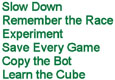 Beginners and Bots
By Steve Flanagan (2003).
Some tips for beginning and intermediate players to improve their games. As you play better, your enjoyment from the game increases greatly.
|
|
|
 Using the Bots
By Kit Woolsey (2000).
The purpose of this article is to examine how we can make the best use of the bots in order to improve our game. First I will play a match, say on GamesGrid. I then have Snowie run through the match. I don't just look at my errors and blunders, although obviously these are the most important. I go through every move step by step.
|
|
|
 How to Use Snowie More Efficiently
By Oliver Heuler (2002).
Research has shown that there is an internal gratification system in our brain. The brain compares old experiences with the new situation. When we find a solution that works, the brain triggers a sense of well-being. This motivates us to solve new problems as well as continuing to follow the successful strategy. How can we use these findings to improve our backgammon skills?
|
|
|
 How to Study Your Own Matches
By Mary Hickey (2015).
Here is the method I recommend for letting your bot assist you in your ceaseless quest for knowledge, enlightenment, and the ability to squash your opponents like so many little ants.
|
|
|
 Becoming a Better Player
By Hank Youngerman (1999).
What you need to become a backgammon player, and what you don't need. The first in a series of articles on practical backgammon.
|
|
|
 Why You Should Teach Your Children Backgammon
By Phil Simborg (2004).
Your kids are going to be exposed to gambling anyway. Isn't it better for them to see that it is possible to compete for the joy of winning and for the trophy, and for the pleasure of doing something well? These are things you can teach your children when you are with them.
|
|
|
It Amazes Me
By Phil Simborg (2007).
There are some players there who have been playing for 20, 30, or more years, who have not improved very little, if at all, in all those years.
|
|
|
 Backgammon Decision Analysis for Success
By Harvey Gillis (2010).
Backgammon teaches a skill set that is essential to success for virtually anything that a person will encounter in their career, investments or personal life. Here is a list of its virtues.
|
|
|
 Posts on Improving Your Game
By Tom Keith.
Many useful suggestions on ways to become a better player collected in the Backgammon Galore Forum Archive.
|
|
|
5 Ways to Improve Your Backgammon
By Sean Williams (2013).
Here are 5 things you can do to maximize your chances of winning.
|
|
|
|
Book Suggestions
|
|
|
 Backgammon Books Worth Reading
By Tom Keith (2004).
Recommended books to read, classified as: introductory books, books for intermediate players, books for advanced players, books of annotated matches, books of collected articles, and books on cube handling.
|
|
|
 Recommended Backgammon Books
By Chris Bray (2007).
There are many backgammon books available. The quality is rising and future books can only add to our store of knowledge on the world's most fascinating game. What follows is a list of essential reading. Study these and you will truly become a much better player.
|
|
|
Hardy's Book Suggestions
By Hardy Huebener (2005).
A selection of recommended backgammon books. The selection is not complete yet, but sufficient to work your way from an absolute beginner to a top backgammon player.
|
|
|
Book Suggestions
By Tom Keith.
Many great suggestions on good backgammon books to read from the Backgammon Galore Forum Archive.
|
|
|
|
Book Reviews
|
|
|
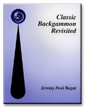 Bagai's Classic Backgammon Revisited
By Marty Storer (2001).
With the help of Snowie 3, Bagai analyzes 120 problems from some of the old classics: The Backgammon Book (Jacoby and Crawford), Backgammon for Profit (Dwek), Backgammon (Magriel), Paradoxes and Probabilities (Cooke), and Advanced Backgammon (Robertie).
|
|
|
 Kleinman's Vision Laughs at Counting
By Mark Driver (2001).
Sold as a two-volume, self-published, spiral bound edition. Volume 1 is Vision Laughs at Counting. Volume 2 is Advice to the Dice Lorn. Kleinman is prolific author noted most for his mathematical genius. He has a gift for putting a number to every conceivable concept of the game.
|
|
|
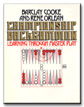 Cooke/Orlean's Championship Backgammon
By Mark Driver (2002).
Cooke was one of the legendary players on the International tournament circuit during the 1960's and 1970's. This book marks the final chapter in Cooke's "trilogy" of backgammon works, after The Cruelest Game and Paradoxes and Probabilities.
|
|
|
 Lamford's Starting Out in Backgammon
By Mark Driver (2001).
Paul Lamford is a former British Champion in both Backgammon and Bridge. This book marks his second venture into the backgammon literary market, following on the footsteps of his successful intermediate/advanced text, 100 Backgammon Puzzles.
|
|
|
 Ortega's Fascinating Backgammon
By Roy Friedman (1993).
This book consists of 50 problems with approximately 100 analyzed positions including all of the variations. The problems cover various aspects of money and match play with emphasis on cube action in the endgame. The author, an experienced international player, has won the Costa Rican National Championship in four of the last five years.
|
|
|
 Trice's Backgammon Boot Camp
By Jake Jacobs (2005).
Walter Trice's book for beginners, intermediates, and experts first appeared online at GammonVillage. Jeremy Bagai liked Walter's series of columns so much that he proposed publishing them as a book. Jacobs writes: "The book is a very attractive paperback running nearly three-hundred and fifty pages, which makes its $40 price tag a bargain."
|
|
|
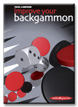 Lamford's Improve Your Backgammon
By Jake Jacobs (2006).
To whom, precisely, am I recommending this book? That's my dilemma. To decide the proper cube actions, Paul has a formula which seems quite effective. The question is: who will use it? I'm afraid it might scare the socks off of most beginners, and old timers are often set in their ways. The book examines the concept of equity, of how it is calculated, and how money and match equities differ. The book is a bargain at $14.95. You can afford it, and it is worth it.
|
|
|
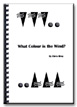 Bray's What Colour is the Wind?
By Jake Jacobs (2006).
This is the collection of Chris's work during the years 1998-2001. In addition to the weekly columns he turned out in the 4-year span there are a year's worth of monthly articles he did for Netgammon in 1999, and an elegy for the passing of Inside Backgammon. Go out and buy Chris's book. You'll enjoy it, and by buying it you will help keep Chris away from the off ramp.
|
|
|
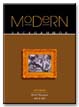 Robertie's Modern Backgammon
By Jake Jacobs (2006).
You must own a copy of Bill Robertie's Modern Backgammon. Robertie looked at hundreds of positions, and tried to divine what sort of principles might underlie and unify the sometimes unique approach that the bots have taken to the game. He identifies four such principles: Efficiency (put your checkers where they'll do the most good), connectivity (what we used to call communication), non-commitment (keep your game plans flexible); and robustness (have spares to play with).
|
|
|
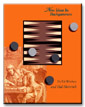 Heinrich/Woolsey's New Ideas in Backgammon
By Jake Jacobs (2006).
This book more than lives up to its billing. I would not recommend it to beginners. Kit's style is clear enough that they will easily grasp his arguments, but beginners need to ground themselves thoroughly in the basics, to master and memorize the rules. This book will fill their heads with exceptions. For everyone else, from advanced intermediate to expert, the book is a must read.
|
|
|
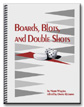 Wiggins's Boards, Blots, and Double Shots
By Jake Jacobs (2006).
This is a book of 129 checker-play problems. Norm tells me that his experts averaged around 60% when they tried these problems. If the experts missed 40%, I'd expect the intermediates to miss at least 3/4. Don't worry, I bet you'll do a lot better the second time!
|
|
|
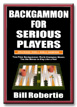 Robertie's Backgammon for Serious Players
By Jake Jacobs (2006).
If you are willing to play, seriously, through each game, covering the player's moves before choosing your own, and spending time rethinking your play whenever it differs with the expert's, this book is for you. Bill is the perfect stylist to give you the right spin on the expert's choice.
|
|
|
Heinrich/Woolsey's New Ideas in Backgammon
By Kate McCollough (1998).
Kit Woolsey was runner-up in the 1996 World Cup, and Hal Heinrich was winner of the 1990 Monte Carlo World Championship. All the positions in this book are taken from actual tournament matches in which a top expert made an incorrect choice.
|
|
|
Wiggins's Boards, Blots, and Double Shots
By Martin Short (2002).
This book has 129 positions rolled out by by Jellyfish and analyzed by the author. The purpose is to help readers develop the ability to see and evaluate the pertinent features of a position and decide which goals take priority over others.
|
|
|
 Ortega and Madrigal's Backgammon: Costa Rica 1994
By Kit Woolsey (1996).
The book examines the Third Tournament of the Américas Cariari Masters final match between experts Mike Senkiewicz and Mike Svobodny.
|
|
|
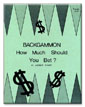 Help for the Hustler?
By Danny Kleinman (1982).
Michelin Chabot with his new book, Backgammon, How Much Should You Bet? addresses two questions: the size of the stakes you should bet, and your cube action. Chabot develops his principles for choosing the stakes from formulas in Richard Epstein’s The Theory of Gambling and Statistical Logic. In discussing cube actions, Chabot introduces two goals, maximizing "hourly expectation," and maximizing "sessional expectation."
|
|
|
Michelin Chabot's Backgammon, How Much Should You Bet
By Kathy Posner (1982).
In recent years there has been a plethora of backgammon books that deal with checker movement, cube strategy, match play, and game theory. Finally there is a book written from a refreshing new angle. Michelin Chabot's book deals with money management and the variables that a player must consider in determining the size of his wager.
|
|
|
Readers' Comments
By Tom Keith.
Many comments collected over the years by readers of popular backgammon books. From the Backgammon Galore Forum Archive.
|
|
|
Rollouts of Robertie’s 501 Essential Backgammon Problems
By Timothy Chow (2009).
Robertie’s excellent book, 501 Essential Backgammon Problems, was first published in 2000. Here are rollouts performed by GNU Backgammon of the most interesting problems in the book. (Only rollout data is provided. You need to have the book to see the positions.)
|
|
|
Rollouts of Wiggins’s Boards, Blots, and Double Shots
By Timothy Chow (2011).
I manually entered all the positions from the book, as well as some variants mentioned by Wiggins in his analysis, into eXtreme Gammon version 1.21. Where XG Roller+ indicated that there might be an issue of some sort, I asked my friend Miller Maley, who owns eXtreme Gammon version 2.00, to perform a full rollout. The most interesting results of this study are presented.
|
|
|
Robertie's Lee Genud vs. Joe Dwek
By Kent Goulding (1982).
Bill Robertie has done an excellent job of annotating the final match of the 1981 World Backgammon Championship Tournament. He starts out with twenty pages of tables, charts, and explanations of proper cube strategies in match play.
|
|
|
Jeff Ward's Winning Is More Fun
By Kent Goulding (1982).
This book is a collection of seventy-five articles, most of which appeared in Ward's syndicated newspaper column. Each article contains one position, usually from an actual tournament game, with a discussion and analysis of alternate solutions. The problems are principally on the intermediate level, and the analysis for that level is quite accurate.
|
|
|
Jeff Ward's The Doubling Cube
By Kathy Posner (1983).
Dr. Ward's plan is to assemble in one place everything one should know about the uses of the cube. He discusses theory and then presents us with positions illustrating his analysis. This first volume covers doubling cube rules, basic cube math, and the role of gammons, and offers six chapters of positions.
|
|
|
Kennedy and Papazian's Backgammon Master Games
By Kit Woolsey (1982).
The current trend in backgammon literature is toward annotated games. A major work in this department is Backgammon Master Games. The book consists of 64 games between top experts collected by Bill Kennedy and 40 problem positions. The games are selected from important matches and expertly annotated by Chuck Papazian.
|
|
|
Cooke's and Orleans's Championship Backgammon
By George Brandt (1980).
The authors have taken a duplicate tournament played in 1973 between two well-known players from England, Phillip Martyn and Joe Dwek as one team, and Barclay and Walter Cooke, father and son. In brief, eight games in the duplicate format are reviewed play by play with analytical comments of each play provided by Barclay Cooke.
|
|
|
Baron Vernon Ball's Alpha Backgammon
By Bob Ciaffone (1981).
Alpha Backgammon is, without a doubt, the most unusual book on the game ever written. Only the first 154 pages deal with backgammon instruction; pages 155 to 209 deal with mind control, ESP, psychokinesis, meditation, self-programming, and drugs.
|
|
|
David Dor-El's The Clermont Book of Backgammon
By Ric Gerace (1980).
Most beginners leafing through the first chapter, titled "Mathematical Information," will immediately seek a simpler game. The problem is overkill in presentation. Generally, the book is solid and basic; the information that the beginner needs to start playing a reasonable game is here. Unfortunately, Dor-El complicates it.
|
|
|
Kleinman's Vision Laughs at Counting
By Mary Hickey (1981).
Danny Kleinman, a Los Angeles computer whiz and backgammon analyst, has put together two excellent collections of writings for serious backgammon players. The subjects covered range from fine points of technique, doubling strategy, money management, and psychology to the wiles of backgammon hustlers and cheats.
|
|
|
Kleinman's Wonderful World of Backgammon
By Mary Hickey (1981).
Danny Kleinman's most recent book reveals secrets of advanced backgammon technique not contained in the author's earlier works. If your backgammon library already includes Vision Laughs at Counting, I strongly recommend that you acquire this new book as well.
|
|
|
Horowitz and Roman's Dynamic Cube Strategy
By Nick Maffeo (1980).
Dynamic Cube Strategy is an excellent contribution to the literature of backgammon. The authors, Gaby Horowitz and Dr. Bruce Roman, are articulate and thorough in their discussion of the principles of cube handling.
|
|
|
Cooke and Orléan's Championship Backgammon
By Mary (1980).
Barclay Cooke's latest book provides a rare insight to the thought processes of a master player during the tense drama of a big match. Assisted by Canadian expert Rene Orlean, Barclay Cooke presents a fascinating play-by-play analysis of the first eight games of the 1973 championship match between Great Britain and the United States.
|
|
|
Phillip Martyn on Backgammon
By Mary (1980).
I would like to call attention to an excellent book that has been available in England since 1976 but has yet to appear on American bookstore shelves. Written by one of England's top players, this book is a valuable complement to the more familiar volumes by Magriel, Cooke, and Deyong.
|
|
|
Typographical Errors in Paradoxes and Probabilities
By Lee Silverstein (1980).
List of errors and corrections for Barclay Cooke's book, Paradoxes and Probabilities.
|
|
|
Goulding's Backgammon with the Champions
By Kit Woolsey (1981).
I have just finished reading the second issue of Backgammon with the Champions, a new publication by Kent Goulding, one of America's top players and an excellent analyst. Each issue contains a fully annotated long match between two experts, usually a late round in an important tournament.
|
|
|
Backgammon Openings
By Neil Kazaross (2007).
Review of Ballard and Weaver's book, Backgammon Openings. This was first published in Carol Joy Cole's Flint Area BackgammoNews newsletter.
|
|
|
Review: Backgammon Openings
By Marty Storer (2008).
A review of Ballard and Weaver's book, Backgammon Openings.
|
|
|
Booktalk: The Backgammon Book
By Richard Frey (1971).
Two top gamesmen take a good look at the other side of the checkerboard. A review of Jacoby and Crawford's The Backgammon Book.
|
|
|
|
Book Transcriptions
|
|
|
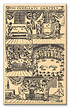 The Compleat Gamester
By Charles Cotton (1674).
One of the earliest books to have a description of Backgammon, though the treatment is pretty light. Also describes these Tables games: Verquere, Grand Trick-Track, Irish, Tick-Tack, Doublets, Sice-Ace, and Ketch-Dolt. (The transcription here is of the "Games within the Tables" portion of the book.)
|
|
|
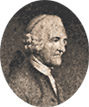 A Short Treatise on the Game of Back-Gammon
By Edmond Hoyle (1744).
A backgammon classic. Hoyle was the first to provide extensive information on the tactics and strategy of backgammon. He showed how to calculate the odds for many different scenarios. His work was copied by other writers for the next 150 years.
|
|
|
 Backgammon: Its Theory and Practice
By Captain Crawley (1858).
One of three books on backgammon by G.F. Pardon (writing here as "Captain Crawley"). It has a chapter on the history of the game, instructions on how to play, and some hints on tactics and calculation of chances. Two sample games are outlined. The book features drawings by Kenny Meadows.
|
|
|
 Draughts and Backgammon
By Berkeley (1895).
Has instructions on how to play backgammon, an illustrative game, information on tactics, and rules for Russian Backgammon. (The transcription here is of the "Backgammon" portion of the book.)
|
|
|
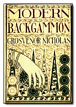 Modern Backgammon
By Grosvenor Nicholas (1928).
This was the first book to describe two new features of the game that contributed to its popularity -- doubling and chouette. You will note there is no mention of a "doubling cube" in the book. That's because it hadn't been invented yet -- in those days they used matches to keep track of the stakes.
|
|
|
 Beginner’s Book of Modern Backgammon
By Ralph A. Bond (1930).
A basic book covering history of the game, list of terms, rules, the opening rolls, basic strategy, chouette, and tables of chances.
|
|
|
 The New Backgammon
By Elizabeth Clark Boyden (1930).
A nicely written book that covers the usual topics: history, how to play, chouette, basic strategy, and rules of the game. Of particular interest is the description of three additional games: Russian backgammon, French backgammon, and acey-deucey.
|
|
|
 How to Play the New Backgammon
By Lelia Hattersley (1930).
This nicely balanced introductory book includes a fair amount of information on strategy, tactics, psychology, and etiquette.
|
|
|
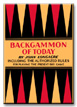 Backgammon of Today
By John Longacre (1930).
One of the better books of the 1930s. Has a fair amount of discussion on strategy, including cube strategy. Includes the rules as standardized by U.S. clubs in 1931, of which Longacre was a committee member.
|
|
|
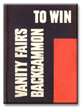 Vanity Fair’s Backgammon to Win
By Georges Mabardi and Clare Boothe Brokaw (1930).
In one of the better books of the 1930s, Mabardi mocks some of his contemporaries: "To see novices rush in arouses the seasoned player’s immediate protest." Clare Boothe Brokaw's chapter on etiquette is well done. The book is a good read.
|
|
|
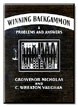 Winning Backgammon
By Grosvenor Nicholas and C. Wheaton Vaughan (1930).
This is a quiz book designed to teach proper tactics. Each position has a series of dice rolls and you, as reader, play the rolls for both sides to see who ends up winning. Then you read the authors' analysis to see if you played correctly. There is also a chapter on calculating "who is ahead" -- essentially a pip count.
|
|
|
 Backgammon in 20 Minutes
By Harold Thorne (1930).
A quickie introduction to the game of backgammon, with instructions on how to set up the board, moving the pieces, doubling, scoring, chouette, and a sample score card.
|
|
|
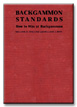 Backgammon Standards
By William H. Walling and William J. Hiss (1930).
The books starts with the usual introduction and how to play the opening rolls. There is a bit on counting rolls and doubling, and then a section on general tactics. The finale is a section on back games, including a complete back game illustrated.
|
|
|
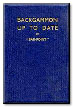 Backgammon Up to Date
By Bar Point (1931).
A basic book covering the rules of the game, chouette, the opening rolls, a bit on strategy, and definition of terms.
|
|
|
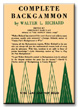 Complete Backgammon
By Walter L. Richard (1931).
One of the best books of the 1930s, it is well-written and quite comprehensive. In addition to the section opening moves, there is a section on replies to the opening moves. The sections on general strategy are accompanied by complete games showing examples of play.
|
|
|
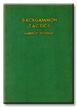 Backgammon Tactics
By Harold Thorne (1931).
A follow-up to Thorne's 1930 introduction to the game, this book goes much deeper into the tactics of the game. There is a section on etiquette, authorized rules for 1931, and an illustrated back game. But the big feature of the book is the section of 50 problems and their solutions.
|
|
|
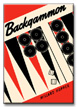 Backgammon
By Millard Hopper (1941).
Lot's of good information in this book. There is an illustrative game, information on basic strategy, faults that typically beset the beginning player, a quiz showing examples of good play, and eight "Golden rules" to remember.
|
|
|
|
|
|
Quizzes
|
|
|
Master's Panel Updated
By Backgammon Times (1982).
Mike Senkiewicz discovered some old issues of Backgammon News, a newsletter published by Prince Alexis Obolensky's World Backgammon Club in the early 1970s. Each issue ran a "Master's Panel" where leading players tackled a series of interesting problems. Here are the problems reprinted, along with the opinions of a new "Masters Panel" assembled by Senkiewicz.
|
|
|
Quiz
By Karsten Nielsen (2008).
The theme is basic understanding of backgammon. There are no positions, only general questions. Some questions have multiple answers. Each answer has a point value. Add up your points and compare with your friends.
|
|
|
 Ed's Backgammon Problems
By Ed Collins (2002).
Six instructive problems with answers.
|
|
|
The Joy of Sets
By Phil Simborg (2008).
There is a downside to rolling doubles: every time you roll a set, you double the chances of your making an error! Here are some examples.
|
|
|
 Othello Quizzes and More
By Japanese Backgammon League (2025).
Tough backgammon quizzes by Masanori Itikawa ("othello"), Kazuya Nagai ("cameron"), Masahiko Kato ("oyajisan4646"}, Motohiro Sugiura ("sugi"), Tsuyoshi Minakami ("minack"), and Paul Weaver ("peever").
|
|
|
 Chow’s Checkerplay Challenge
By Timothy Chow (2011).
Test your backgammon skill by finding the top play in each of ten challenging checker-play problems.
Checkerplay Challenge #1
Checkerplay Challenge #2
Checkerplay Challenge #3
|
|
|
Backgammon with the Champions' Panel of Masters
By Kent Goulding (1982).
Experts of the day tackle five problems, giving the reasons for their choices.
|
|
|
Some Unusual Cube Decisions
By Mike Senkiewicz (1982).
Here are eight positions that have turned up in my backgammon travels involving unusual and surprising cube decisions. Before reading what I have discovered about them, decide for yourself what the proper cube action should have been by both sides.
|
|
|
Checker Quiz
By Bill Robertie (1981).
In each of 20 positions Black is on roll in a money game, with the cube positioned as shown. Find the best play for Black's indicated roll then check your answer with the one provided by Robertie and read his comments.
|
|
|
Doubling Quiz
By Bill Robertie (1980).
In each of 12 positions, Black is on roll in a money game with the Jacoby rule and beavers in effect. For each position, answer these two questions: (a) Should Black, on roll, double or not? (b) If Black doubles, should White drop, take, or beaver? Then check your answers an read Robertie's comments.
|
|
|
Doubling Quiz 2
By Bill Robertie (1980).
In each of 12 positions, Black is on roll in a money game with the Jacoby rule and beavers in effect. For each position, answer these two questions: (a) Should Black, on roll, double or not? (b) If Black doubles, should White drop, take, or beaver? Then check your answers an read Robertie's comments.
|
|
|
Gammon-Saving Quiz
By Jeff Ward (1981).
In each position, Black owns the cube and is on roll in a money game. Black has fifteen men on the board; White has less. Select the best play for Black's roll.
|
|
|
Double Ace Quiz
By Kit Woolsey (1981).
While many awkward rolls restrict our possibilities, the most flexible roll is undoubtedly double aces. With this roll there are usually many options available, and we can position our men as we wish in order to carry out the game plan called for by the type of position.
|
|
|
Match Doubling Quiz
By Kit Woolsey (1980).
In the early stages of a long match, cube strategy should generally be the same as in money play. When one or both players are knocking on the door of victory, however, cube strategy becomes totally dependent on the score. Analyze the following positions, and determine whether or not you would send the cube over.
|
|
|
|
Annotated Games
|
|
|
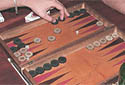 Annotated Match: Kit Woolsey vs. Jeremy Bagai
By Kit Woolsey and Jeremy Bagai (1994).
In February of 1994, Kit Woolsey and Jeremy Bagai thought it would be a good idea to annotate a match for FIBS players so they could see the thinking processes of the more experienced players. They played a fairly interesting match, logged it, and then annotated it independently.
|
|
|
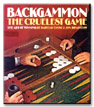 Three Great Games
By Barclay Cooke and Jon Bradshaw (1974).
Transcriptions of three games with commentary by Cooke and Bradshaw. Every position that was commented on is also rolled out. (From Backgammon, the Cruelest Game, Chapter 11.)
|
|
|
Monte Carlo 2003 World Championship Final
By Albert Silver (2003).
The final 25-point match of Monte Carlo 2003 was between Moshe Tissona and Jon Royset. Expert commentary provided by Casper van der Tak, Chuck Bower, Alex Zamanian, Tom Suzanski, and Kit Woolsey.
|
|
|
Pasko vs. Motakhasses: The Turnberry Isle Final
By Kent Goulding (1983).
This game is between Jim Pasko and the legendary Kuamar Motakhasses. It was the fifth game in the finals of the Turnberry Isle Championship last October.
|
|
|
Malcolm Davis vs. Chris Peterson
By Bill Robertie (1982).
The B.S.O. Benefit Tournament was won by Malcolm Davis of Texas who made his first appearance in the New England area. Davis beat Chris Peterson, formerly of Boston but now residing in New York, in the finals. This is the penultimate game of the finals.
|
|
|
Mike Maxakuli vs. John Karian
By Bill Robertie (1982).
This year's Holiday Tournament in Las Vegas was won by 1981's most successful tournament player, Mike Maxakuli, the editor of Las Vegas Backgammon Magazine. Runner-up was John Karian of Los Angeles, who reached the finals for the first time in his tournament career. This is a game from the final match.
|
|
|
Paul Magriel vs. Berj Abadjian
By Bill Robertie (1982).
The Open Section of this year's Plimpton Cup featured one of the strongest fields assembled anywhere in the world. This game is the first of the 5th-round match between Paul Magriel and Berj Abadjian.
|
|
|
Bill Robertie vs. Simone Naim
By Bill Robertie (1984).
When Bill Robertie won the Championship at the Monte Carlo tournament this past summer, he played some of the toughest players in the world. This game comes from the exciting final match against Israeli Simone Naim.
|
|
|
Test Your Backgammon: Paul Magriel vs. Bill Robertie
By Bill Robertie (1982).
How often have you complained that you could play as well as the famous players, if only you could get their positions and great rolls? Well, here's your chance to prove your point. At critical points in this match between Magriel and Robertie, try to guess the next play. Keep a running total of how well you do. A scoring guide is provided at the end.
|
|
|
Magriel-Magriel vs. Davis-Woolsey
By Kit Woolsey (1983).
This interesting game occurred in the first round of the doubles event at the recent Holiday Tournament. My partner was Karen Davis, and our opponents were Paul and Aileen Magriel.
|
|
|
No Defense to the Backgame?
By David Leibowitz and Elliott Winslow (1981).
How do you beat a backgame? You make a prime to force his game to crash. But what if his timing is just too good? A novel approach was seen in a match played in Boston by two of New York's superstars, Al Hodis and Erik Seidel. The key was: if you can't defend, then attack!
|
|
|
1979 Monte Carlo World Championship
By Bill Robertie (1980).
The final match for the 1979 World Championship of Backgammon in Monte Carlo pitted Jeff Westheimer of the United States against Luigi Villa of Italy. The 21st game proved to be the turning point of the match.
|
|
|
1981 Monte Carlo World Championship
By Bill Robertie (1982).
Six days earlier, 250 players had begun competition in the main flight of the tournament. By Sunday, July 12, 1981 only two remained: Joe Dwek and Lee Genud. Unlike the last several years, these two participants boasted formidable reputations. As the match developed, the lead seesawed a bit, although there were no big swings. Then came the remarkable thirty-fifth game.
|
|
|
Last Chance Match
By Kit Woolsey (1981).
This match was a first-round last chance match in the Chicago Black & White Tournament last year between Nick Ballard and myself. Thanks to Elliot Winslow for recording the match.
|
|
|
|
Blogs
|
|
|
 Position of the Day
By Chris Bray (2016).
A great collection of cube an checker problems posted one-per-day by backgammon author Chris Bray.
|
|
|
Bill Robertie's Blog
By Bill Robertie (2015).
Chouettes, early game, holding game, middle game, tournament tips, tips for beginners, learning backgammon, backgammon generally.
|
|
|
Backgammon Camp
By Anonymous (2009).
The main focus of this blog, is to work through Backgammon Boot Camp by Walter Trice. My hope is that a few like minded people wanting to improve their Backgammon play will join me in doing this. By sharing information and comments we can improve together.
|
|
|
The Dorbel Daily
By Paul Money (2013).
A collection of random checker and cube problems are discussed: Cube Thoughts, Stacks of Problems, High-ho Silver, Without a Net, Confession Is Good for the Soul.
|
|
|
Backgammon for Beginners
By Anonymous (2011).
Various topics for beginners.
|
|
|
Dubrovnik Backgammon
By Anonymous (2011).
Checker and cube problems.
|
|
|
|
Checker Problems
|
|
|
Paul Magriel's Columns in the New York Times
By Tom Keith (2013).
From June 1977 to July 1980, Paul Magriel wrote a weekly column on backgammon for the New York Times. The columns are presented here as they originally appeared, with photos added and rollouts of every position.
|
|
|
GGraccoon Speaks Out
By Mary Hickey (2001).
The three positions discussed here all arose in matches on Gamesgrid with GGraccoon. (GGraccoon is a bot.)
|
|
|
 GGraccoon Speaks Out Again
By Mary Hickey (2003).
The positions discussed here all arose in matches on GamesGrid with GGraccoon.
|
|
|
When God is Wrong
By Kit Woolsey (2001).
A collection of positions which Snowie appears to have misevaluated. These are not small technical errors. They are big conceptual errors, where the difference between Snowie's 3-ply evaluation and the rollout results is quite large.
|
|
|
 Peever's Errors vs. Kit Woolsey
By Paul Weaver (2001).
On September 26, 2000 Kit and I played a seven point match on GamesGrid. I kept my laptop busy for over a week rolling out positions from the match. Although Kit humbly gave me permission to discuss his mistakes, there are more than enough of my own errors to keep me occupied.
|
|
|
Kit Woolsey Revisited
By Phil Simborg (2008).
Another look at a problem posed in Chicago Point in 1993 and analyzed by Kit Woolsey.
|
|
|
A Controversial Move
By Dan Heisman (1983).
This position occurred a while ago at the Cavendish Club in Philadelphia. I was captain in a 5-person chouette. Immediately all three of my crew yelled, "Hit and make the 5 point!" I wasn't so sure.
|
|
|
An Objective Viewpoint
By Gaby Horowitz and Bruce Roman (1980).
This position occurred in the early rounds of the Championship flight of the 1979 American Backgammon Championships in Las Vegas. After the match we saw a group of Mayfair players studying a position that Mr. Senkiewicz was showing them. Characterizing the move of breaking the bar point as hopeless, he was lamenting his "misfortune" of losing to a player who would make such a terrible move.
|
|
|
The Fundamental Point
By Mike Labins (1983).
A position taken from Competitive Backgammon, Volume II, by Labins, Storer, and Talmadge, which arose during one of Paul Magriel's matches at the 1980 NEBC Black-and-White Classic in Boston.
|
|
|
Anticipate Your Opponent's Problems
By Jerry Nathan (1983).
Black would like to have played one checker 7 pips from the mid-point to his 6-point, but his conscience would not allow him to make this illegal play--both the 1 and 6 were blocked.
|
|
|
The Best Spot for This Blot
By Jerry Nathan (1982).
If Black could have stayed out of range of White's man on the 2 point with one or both of his outfield checkers, he might have chanced the throw of a 6 that White needed to escape. Two men would have the opportunity of returning White's blot to the bar.
|
|
|
What Did I Miss?
By Bob Hickey (1981).
As a weak intermediate-level player, I often find myself confused by various plays in expert circles and current backgammon literature. The latest is from Labins's and Jerauld's book, Competitive Backgammon Volume 1.
|
|
|
The Computers
By Barclay Cooke (1980).
Recently, a computer known as BKG 9.8 beat the current World's Champion, Luigi Villa. Hans Berliner writes about the prowess of his computer in Scientific American. There is one critical position where I disagree totally with the computer's move, a move heartily praised by Berliner.
|
|
|
The First Step in Learning
By Gaby Horowitz and Bruce Roman (1981).
Robert Hickey wrote an article in the March 1981 issue of Las Vegas Backgammon Magazine asking about a position from Labins's and Jerauld's book, Competitive Backgammon. Horowitz and Roman respond to Hickey's query.
|
|
|
All or Nothing at All: A Basket of Eggs
By Paul Magriel (1980).
Crockford's Club in London is one of that city's oldest gaming establishments. In addition to a major international tournament once a year, the club also holds local tournaments three times a week for beginners, intermediate, and advanced players. This position occurred at one of the tournaments.
|
|
|
Lowly 1-Point Can Take On Great Importance
By Paul Magriel (1980).
The Eldorado Backgammon Classic was held recently in Reno. The tournament drew most of the top players from the West Coast. Dennis Stone demonstrated his skillful technique in a position taken from his semifinal match against Magriel.
|
|
|
How Little We Know
By Jim Pasko (1980).
The interesting thing about this position is that each play leads to a completely different game plan. Furthermore, I noticed some startling facts. The first choice of the great majority of the top players was most likely the worst solution and the two choices selected least often were in fact almost certainly the two best choices.
|
|
|
The Power of a Seven-Point Prime
By Jeff Ward (1981).
When is a seven-point prime better than a six-point prime? Most players with even a little experience would probably answer "never" to this question. Since a six-point prime is an impassable barrier for opponent's men trapped behind it, what possible purpose could there be for a seventh point?
|
|
|
|
Cube problems
|
|
|
 Sixteen Cube
By Kit Woolsey (2001).
Some exciting cube decisions from the Las Vegas Open in 2001.
|
|
|
Pro Am 2002
By Kit Woolsey (2002).
Several interesting positions from a match between Kit Woolsey/Donald Kahn and Mike Senkeiwicz/Wayne McClintock in the 2002 Pro-Am.
|
|
|
 Viva Las Vegas
By Kit Woolsey (1999).
Woolsey discusses positions from the 1999 Nevada Backgammon Tournament.
|
|
|
 Vegas 2003
By Kit Woolsey (2003).
Several interesting positions from the recent 2003 Vegas Tournament.
|
|
|
The Finesse of a Master
By Gaby Horowitz and Bruce Roman (1980).
The Finals of the 1980 Eldorado Classic in Reno, Nevada brought two of the best face-to-face in an exciting confrontation. It was the best two-out-of-three nine-point matches with the first match going to Paul Magriel and the second to Chuck Papazian.
|
|
|
Use the Cube As a Weapon, Not As a Gift
By Gaby Horowitz and Bruce Roman (1979).
Occasionally you may take a questionable cube if you wish to attempt to demoralize your opponent by accepting the double and subsequently turning the game around. This may be forgivable, but it is never forgivable to give a bad cube. In these six positions, we examine some "gifty" doubles and some sound doubles.
|
|
|
|
Recorded Matches
|
|
|
 Paul's Backgammon Vaults
By Paul Stephens (2005).
Large collection of recorded matches from Norges Backgammonforbund, BGBlitz vs. GnuBG, and Jellyfish vs. Snowie.
|
|
|
Hardy's Match Archive
By Hardy Huebener (2007).
Many important matches from top tournaments for download. Analyzing those matches is very instructive! Most matches are in .mat format which can be imported by Gnu Backgammon and Snowie. Some matches are also available in .sgf format (GNU Backgammon), which contain analysis.
|
|
|
 Towards a Better Method of Recording Backgammon Games
By Jay Bidal (2007).
There are several good systems used by those who manually record live backgammon play for post-analysis. In this article, Jay Bidal offers the system he uses to those who want to learn a quick and easy way of recording a match.
|
|
|
Recording Backgammon Games
By Hideo Kato (1981).
I have invented a system of recording games of backgammon which can be used to record games played at normal speed. I believe my system is very helpful to take record of such games as the final of a tournament or expert-vs.-expert match which are played on usual backgammon board and in usual expert's speed.
|
|
|
A Fast Way to Record Backgammon Positions
By Jeff Ward (1981).
Most people record a position by drawing a picture of the board and the men. To save time, some players used preprinted diagrams of an empty board. Even so, it is still time-consuming and tedious. To get around this problem, the author has developed a notation system that is fast, easy to use, and does not rely on preprinted diagrams.
|
|
|
Last updated: 24 Oct 2026
|